

Nurture and Young Imagination
By Bob Kirchman
This Originally Appeared in Lost Pen Magazine
Imagine if schools actually helped kids identify their strengths by exploring their talents from a young age and growing their skills over the 12 years instead of letting them all follow the same routine like sheep and leaving them confused after graduation.” – Tallie Dar
Imago Dei
I’m thinking about a wonderful illustration my supervisor at the homeschool coop, Amanda Riley, gave to the students. She brought a box into the room and challenged all 17 students to get into the box – all at once! The result was a bit of organized chaos that proved conclusively that all the students could NOT fit into the box! She then proceeded to underscore the uniqueness of each of our beautiful students. Imago dei carries with it the same wonder that you find in handmade pieces of fine pottery; no two of them are ever actually the same.
Yes, our job as educators is to provide a platform of basic grammar to facilitate our mutual growth and interaction, but I’m now convinced that we too often fail to see what our students are emerging to become as Divine works. I’m reading the novel Mink River by Brian Doyle. Of particular interest to me is the sculptor, Nora, who listens to the art medium—blocks of wood or stone—in order to learn what they want to be while she chips away at them. So often, we hear the malleable clay illustration applied to students, but they are more like Nora’s wood or stone. We (teachers) begin with the chisel and hammer, but even in the noise of chipping we must listen!
My mother once took me to visit a friend of hers who was a sculptor. Somewhere in a conversation about sculpting,the old saying, “You cut away everything that doesn’t look like an elephant,” came up. Actually, that is not how great sculptors work. Like Nora above, great sculptors seek the elephant that is saying that it’s in there!
At school, my eyes scan our classroom full of unique works in progress. The future healers and builders and poets and prophets interact with artistic mediums and hints emerge as to what the Divine is shaping in them. They will go out into the world and continue this process. Can what we do here serve to help them identify the grain and composition that they have been made with—and out of it shape a life pleasing to their maker?
The Wilderness Years
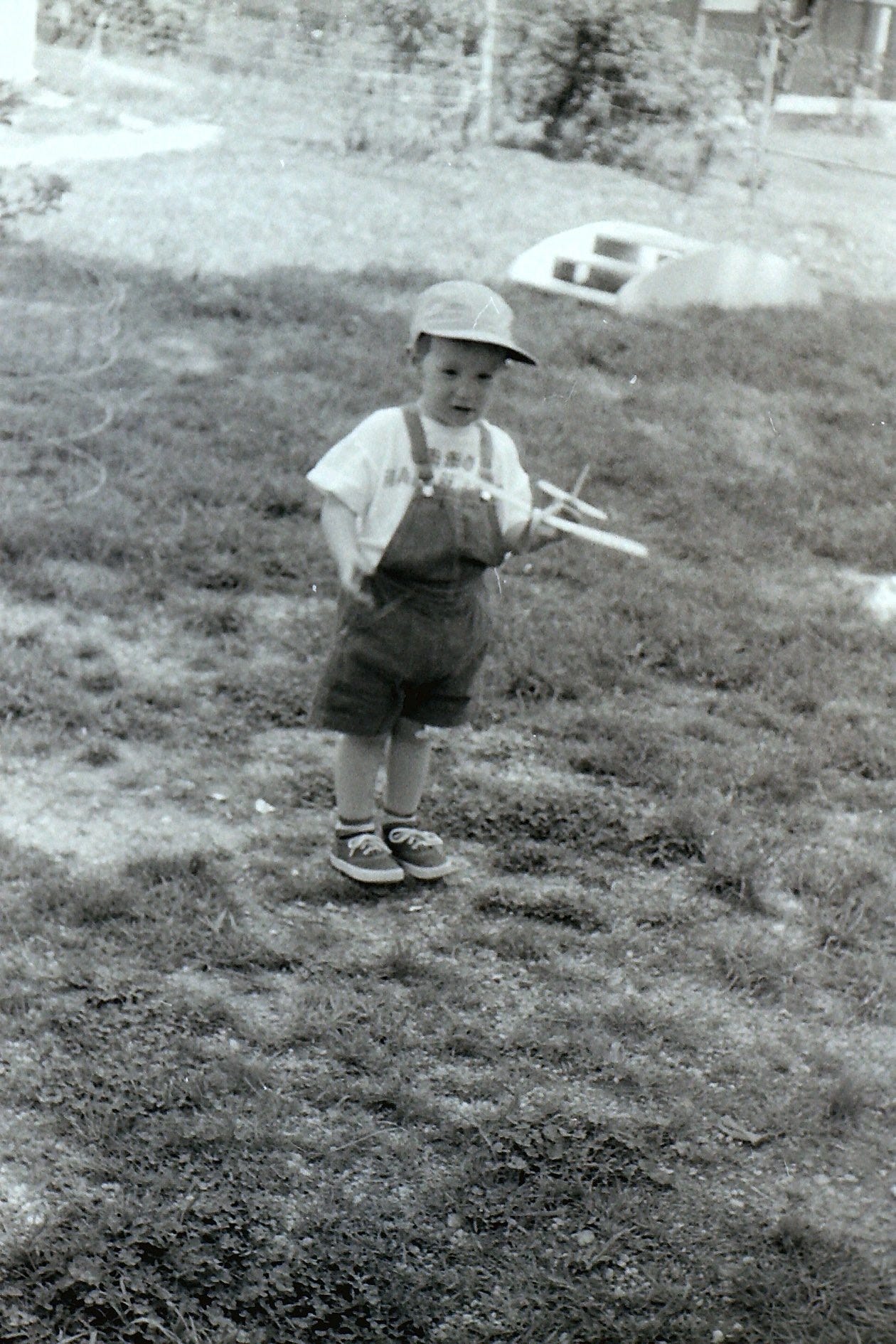
I think of my own childhood. At five, I think I remember Mom putting some construction paper, glue, and scissors out on the picnic table behind our house on a glorious spring day. My sisters and I proceeded to create a little village of paper houses! It was a day of glorious satisfaction as we placed them into natural settings. Another time, Dad gave me little model airplanes and my first camera, a Brownie Hawkeye. The wonderful thing about the Brownie was that it shot 21/4” film, so although it was no Hasseblad, its plastic lens still rendered an incredibly crisp image. Since it only shot black and white, it came with a red filter so you could get pretty good clouds and sky! Dad shot his work with an Argus C3, which I eventually inherited. By the way, he took the photos that accompany this article. He was an engineer at NASA who wore a white shirt and a narrow tie. Behind his pocket protector their beat a wild heart!
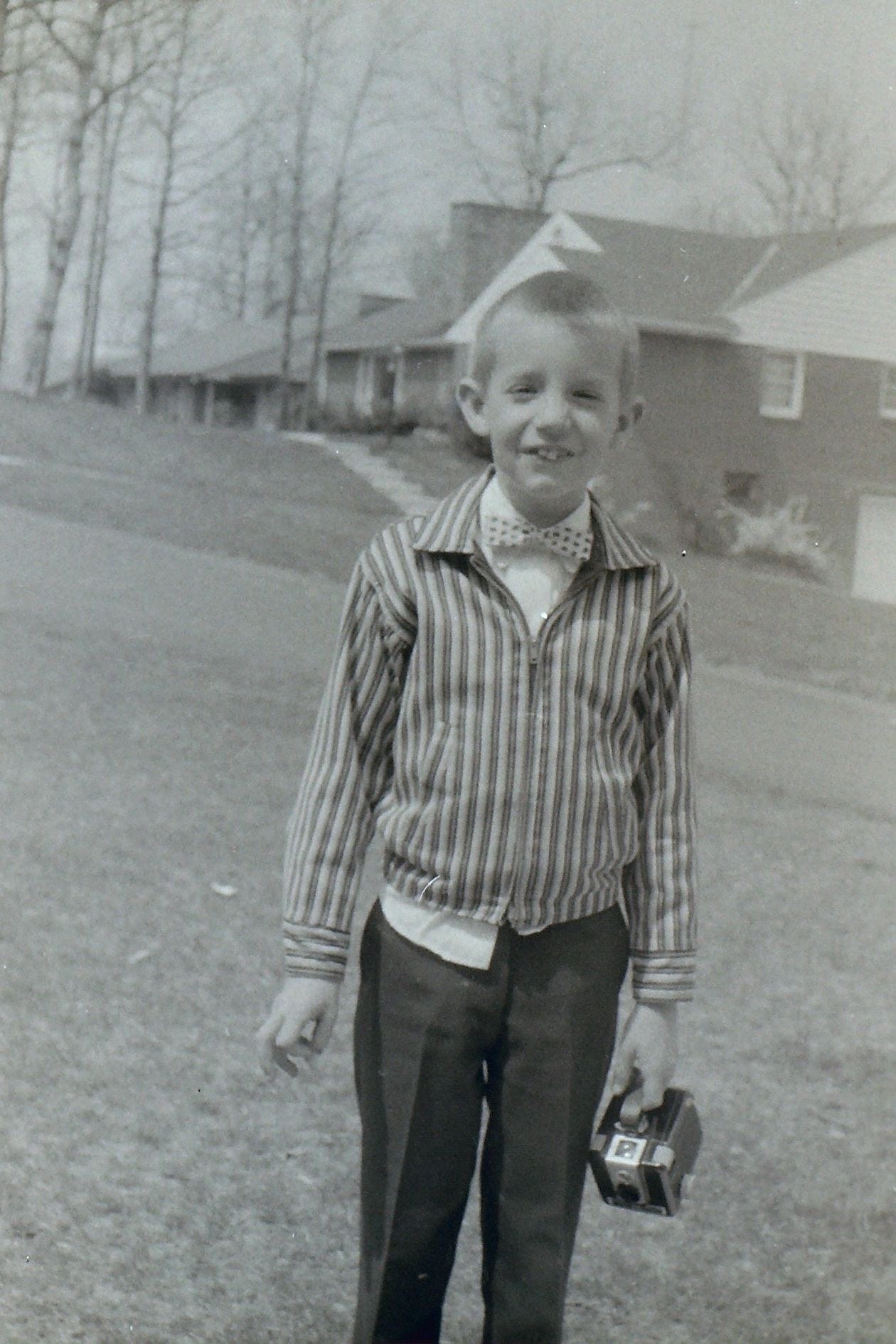
Dad was trained in the day when engineers were not trained in the humanities, but he developed his own love for fine literature and had an extensive library. He wrote papers on spacecraft structural dynamics and testing but at night he went home and read Shakespeare and Chaucer. Mom was a physicist and an engineer and she was even more of the Renaissance person. Such was the world of my preschool existence, but it was the 1950’s after all and the big modern school and the industrial model of education prevailed. At six-years-old, I was packed off to a classroom with fifty students and entered the world of waxed hallways, antiseptic smelling restrooms and rote learning. By second grade I lamented that I had become a very ‘badkid’ and was pretty much always in trouble for something. Sometimes I understood the infraction, sometimes it was a mystery. I became a quiet rebel: I drew pictures and hid them under my bed. One of my teachers tore up a very nice drawing I had made of a T-rex. She told my dad I’d be lucky to be a truck driver. I continued to draw and hide the pictures under my bed.
Somewhere along the way I discovered John Gnagy’sLearn to Draw books. They taught me a lot of the basics. I found one of my Dad’s books on aircraft design. It was full of curves and calculus and wonderful elevations of airfoils. In the back there was a chapter on drawing perspective. The discovery of that chapter was an epiphany.
One day, my dad noticed that I could draw a fairly decent perspective (before I’d had any formal training), so he had me do a pencil drawing of a building he was proposing for his facility at NASA. I think he even paid me for it. I was twelve-years-old and that was my first architectural rendering.
But I think most of the adults in my greater sphere saw me as a daydreamer. Under my bed, my pile of fantastic imaginings continued to grow– undersea worlds, cities on the moon—but on the outside I was resigned to the life the world poured me into. Driving a truck didn’t seem that bad. It would be kind of like a monastic life on wheels and you could see the country.
When I was older, I would learn of how Albert Einstein, the great theoretical physicist, had struggled in school. He, I would learn, was a daydreamer too. He barely passed school and then he couldn’t get a job in academia. That might have been why he found the path to brilliance. He took a job as a patent clerk in Berne, Switzerland. His job was to read the applications and recommend the good ones. Well, he became so proficient at analyzing the patent applications that he ended up with plenty of time to just stare out the window – and IMAGINE! “What would it be like to travel faster and faster away from the great clock tower in Berne. As you approached travelling at the speed of light the hand on the clock would appear to move ever slower. Then you reach the speed of light. The hand of the clock is now standing still. If you can travel faster, the hand of the clock is now moving backwards!’ From this little journey of imagination came new insight into the very nature of time, energy, and matter! Brilliance nurtured by space to develop opened up the greatest mind in modern times.
But what if a discouraged Einstein had, as he once considered doing, gone on to sell insurance? He might have had a comfortable existence but his mind would have never taken that accelerated journey to brilliance. He would have been successful in the world’s eyes, but at what cost! Another equally plausible scenario is that Einstein would have been admitted into academia in his younger days. He would have been consumed by the politics of the academy and writing papers of far less importance than his theories of gravity and general relativity. He would have lived his life as a successful but quirky professor without ever engaging in his great work. It was the wilderness years that played an important part in his development.
There seems to be no course of study in academia to take you through the wilderness years. My early wilderness years saw me as a grill chef and a factory worker. But somehow I found myself in my mind travelling faster and faster to the other things I would later be able to do. If I could give one thing to a young person in the wilderness it would be a heightened sense of imagination. Imagination is not limited in speed to the currently available technology and it costs very little as well. A prince and a pauper can both access it and it may take either on a journey of great significance. Two bicycle mechanics can imagine flying machines. An air mail pilot can imagine flying the Atlantic. A German munitions designer can envision a trip to the moon! Imagine if schools…
Whatever you think of Elon Musk, whatever you think of the practicality of some of his ideas, it is well to consider that he represents but the latest expansion in humankind’s ability to imagine. Last year in our classes we had two sisters who collaborated to create a concept for an undersea resort, right down to such furnishings as a jellyfish lamp sconce for the hallways. Imagination! It is a gift possessed by the youth. What indeed should be our mission as educators when such illumination presents itself? Should not we ourselves find a passion to discover and nurture such wonder? And should not our nurture extend beyond the giving of tools and instruction to making sure the tool fits confidently into their young hands?
Our Students are In the Youth Art Show!
[click to read]
